Until the arrival of the railways in the mid 1800s and then cars in the 1900s, coaching inns were the equivalent of modern-day motorway service stations, bus stations and railway stations combined. They provided food and accommodation to travellers and their horses. Private coaches were catered for and the inns also acted as hubs for mail coaches and public stagecoaches travelling between towns and cities. Travellers who were in a hurry could exchange tired horses for fresh ones.
Stagecoaches were four or six wheeled closed carriages with the ability to carry several passengers and a small amount of luggage. They would be drawn by four or six horses. They could reach a top speed of four to five miles per hour on the new turnpike roads.
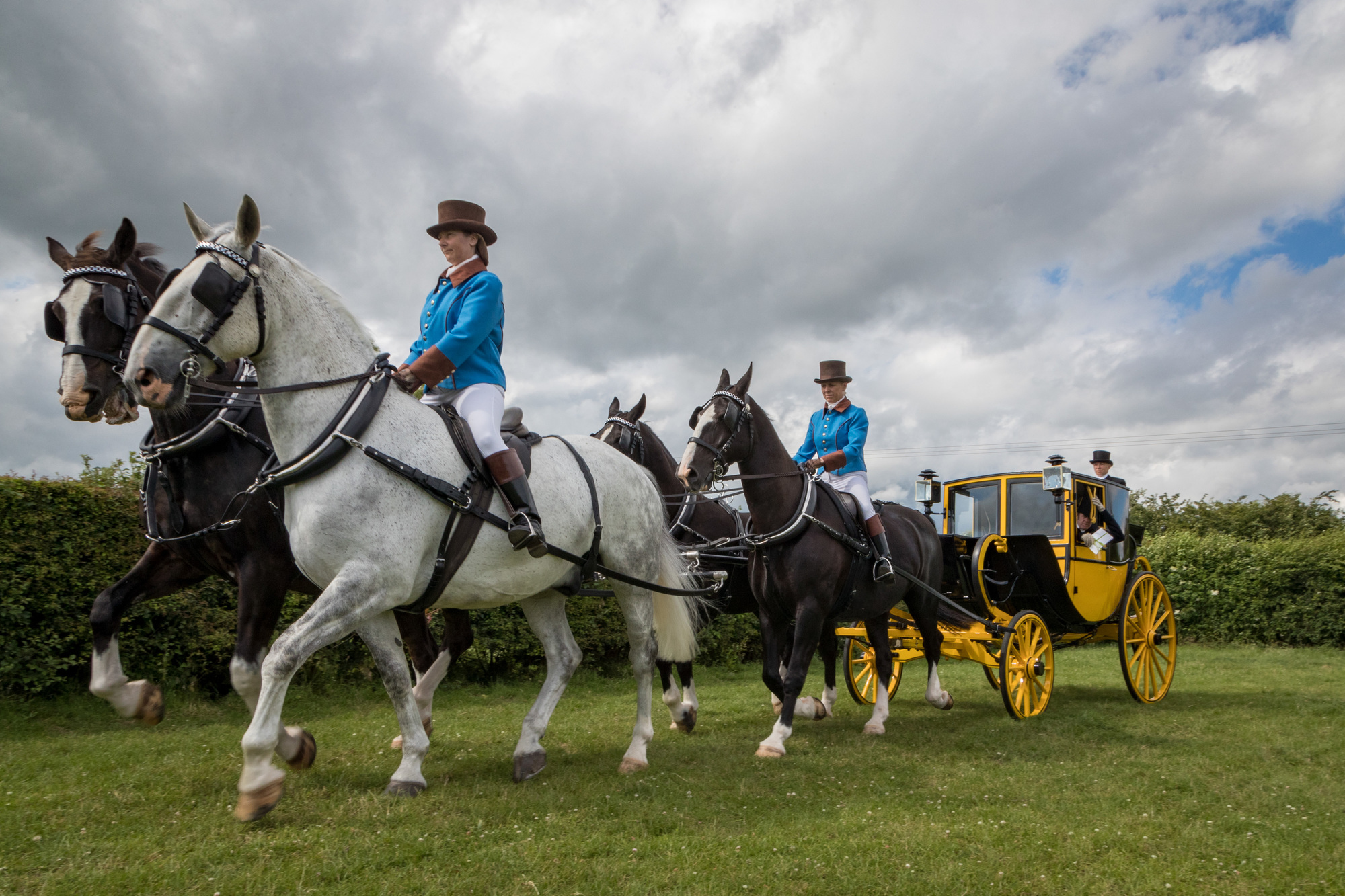
If you were in a real hurry, and had the money to spare, you could hire a post-chaise and achieve a hair-raising speed of eight to ten miles per hour. This was a small closed carriage, seating two people. There was no driver’s seat. The chaise would be drawn by two or four horses and rather than having a coach driver, the horses on the left-hand side of the carriage were ridden by postillions (also known as postboys), who wore smart uniforms with special leg-protectors for the right leg. The carriages were always painted bright yellow. The post-chaise would travel from posting station to posting station. Horses and postillions would be changed at each coaching inn, so that they were always fresh and capable of travelling as fast as possible. This relatively fast form of travel may be where the term “post haste” comes from. It’s been suggested that New York yellow cabs were inspired by the yellow coloured post-chaises. There's a picture of a post-chaise here.
We have three sets of relatives who ran inns in fairly close proximity along the route from London to the West Country.
John Hall of Mapledurwell - died 1765.
John was Mary Alice Willis’s 4X great-grandfather. Information on John is a bit lacking at the moment. He married Sarah Tees (born 1726, Sherfield-on-Loddon, Hampshire). They had three daughters, Sarah born 1751, Mary born 1753, and Aves born 1755, died 1759.
John was an innholder at Mapledurwell Hatch, Hampshire. In his time it would have been a small village. Nowadays, it’s on the edge of Basingstoke, close to the M3 motorway. He left his property, which comprised the inn and land surrounding it, to his wife and then to his two surviving daughters. I haven’t been able to definitely identify the inn but think that it was probably the Hatch, previously known as the King’s Head. Google Maps street view.
John’s eldest daughter, Sarah Hall, married Joseph White of Staines in 1771. Joseph was the proprietor of the Bush Inn, Staines. There’s more to come about Joseph and Sarah and their family further down the page.
John’s second daughter, Mary Hall, was Mary Alice Willis’s 3X great-grandmother. Mary Hall married Michael Willis in 1772. They lived in Wraysbury until Mary’s death in 1804 and had one daughter, Mary Ann. Mary Ann married John Goodwin of Datchet and two of their daughters married back into the Willis line - complicated isn’t it? Juliana Goodwin and Charles Willis were Mary Alice Willis’s great-grandparents.
Michael Willis married again after the death of Mary Hall. His new wife was a widow, Ann May (maiden name Webb), she was also from the Basingstoke area and was related to some of our other forebears.
Timothy Harris 1675 - 1748.
Timothy was Mary Alice Willis’s 5X great-grandfather on another branch of the family leading into the Willis line. He was born in Salisbury but by about 1700 he was running the Red Lion Inn at Egham, not that far from Mapledurwell. After Timothy’s death the inn was run by his daughter Ann Harris until about 1784.
The Red Lion is still in existence today Google Maps Street View . It was a large coaching inn with accommodation for 72 horses. I’ll write some more about Timothy in another story.
Joseph White 1751 - 1810 and Sarah Hall 1751 - 1801.
Sarah Hall was Joseph’s second wife. They were married at Mapledurwell in 1771. They had seven children, including Harriet, who was born in 1776. Harriet became the wife of James Willis in 1794. James was the son of James Willis and Elizabeth Tebb and he was the elder brother of our ancestor, William Willis. After the death of their father in 1794 James and William ran the Thatched House Tavern and Almack’s Assembly Rooms.
Joseph White was the proprietor of the Bush Inn at Staines. It was a large coaching inn, capable of stabling a hundred horses. In 1789, he announced in the Reading Mercury newspaper, that he had converted the Red Lion at Egham (see above) to an Assembly Room. There would be a ball and supper on the Tuesday of Easter week and in the future there would be balls, public breakfasts and card assemblies.
Joseph’s business ventures don’t seem to have been a great financial success - a couple of phrases originated from there - being "at Staines" or "at the Bush" were euphemisms for being in financial distress - according to Google! In May 1795 a notice appeared in the Reading Mercury newspaper stating that Joseph White’s goods at the Bush Inn were to be sold by auction - presumably he was on the point of bankruptcy. The sale was to include his “entire stock of horses, carriages and harness &c comprising fifty eight capital-seasoned well-known good porte-chaise and machine horses, four milch cows, pigs &c, five post-chaises, a post coach, a waggon, two carts, a whisky and several lots of harness &c.” Presumably, he was bailed out at the last minute - he was still running the Bush Inn when he died in 1810. Sarah had died in 1801. The business was carried on by their eldest son, another Joseph.
Joseph junior continued at the inn until 1827, when he moved to the Castle Inn at Marlborough - it subsequently became Marlborough College in 1843, after the arrival of the railway and a consequent loss of trade. The contents of the Bush Inn had been put up for auction, including 60 goose feather beds and handsome old and modern china. (I am on the lookout for some of the old china marked “White Bush Inn”!) Also up for sale were upwards of thirty posting horses in high condition, five post-chaises, two black mourning coaches, one hearse and harnesses.
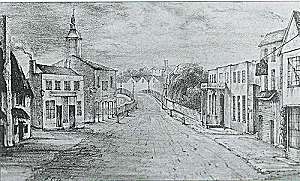
The Bush Inn was demolished in 1832 when the old bridge over the Thames was removed and replaced with a new one. A new inn was built, it’s currently called The London Stone. Staines Town Hall, now known as the Old Town Hall, is situated approximately where the original Bush Inn stood. There’s a small picture showing the old inn here.
The Trafalgar Way.
In 1805 George III was on the throne and Britain was at war with France. An invasion by Napoleon was imminent. A battle at sea, off the southern coast of Spain, commenced at midday on the 21st of October 1805 - The Battle of Trafalgar. Admiral Villeneuve commanded the French and Spanish fleet. On the British side, Vice Admiral Collingwood was on board HMS Royal Sovereign, and Vice Admiral Nelson commanded from HMS Victory. By 5pm the battle was over, the French and Spanish were defeated but Nelson had been mortally wounded and died at about 4:15pm.
Shortly after the Battle of Trafalgar ended a huge storm struck, delaying communication with Britain. Five days later Collingwood ordered Lieutenant John Richards Lapenotiere to deliver news of the victory and the death of Nelson to the Admiralty in Whitehall with all possible speed. Lapenotiere set off in his fast schooner, HMS Pickle, and landed at Falmouth, Cornwall on the 4th of November. He set off for London immediately in a post-chaise. He travelled 271 miles in 38 hours with 21 changes of horses along the way. The whole journey cost in excess of £4,000 in today’s money.
In 2005, 200 years after the battle, the journey was commemorated using a replica post-chaise and plaques were put up along the route where the horse changeovers occurred.
On the 5th of November 1805 Lapenotiere made his 17th stop to change horses at Basingstoke at a cost of £1/14s. A plaque can be seen inside the Willis museum at the foot of the stairs. You can see a picture and map here. The Willis name in this case is purely coincidental. The next stop was Bagshot and to get there Lapenotiere would ride through Mapledurwell and pass by the Hatch.
The next stop after Bagshot was Egham and a plaque has been installed on the High Street - picture here. The horses were still fresh, a change was not necessary so Lapenotiere continued on to his 20th stop - The Bush Inn at Staines.
There are two plaques commemorating his arrival at Staines on the wall of the Old Town Hall in Market Square. An older plaque records the details of Lapenotiere’s arrival in Staines and also mentions that Nelson and Lady Hamilton actually stayed at the Bush Inn in 1802. The second plaque is in the same form as the previous ones along the route. I can’t find a photo that’s legible. Here is a transcription :-
“The Trafalgar Way Staines - 20th Post-horse change On Monday 21st October 1805 the Royal Navy decisively defeated a combined French and Spanish fleet off Cape Trafalgar on the south west coast of Spain. This victory permanently removed the threat of invasion of England by the armies of Napoleon Bonaparte. The first official dispatches with the momentous news of the victory, and the death in action of Vice Admiral Lord Nelson, were carried to England on board H.M. Schooner Pickle by her captain, Lieutenant John Richards Lapenotiere. Lapenotiere landed at Falmouth on Monday 4th November 1805 and set out "express by post-chaise" for London. He took some 37 hours on the 271 mile journey, changing horses 21 times. The 20th such change was made at Staines late on 5th November at a cost of one pound seventeen shillings and sixpence. Lapenotiere delivered his dispatches to the Admiralty at 1a.m on Wednesday 6th November. The news was at once passed to the Prime Minister and the King, and special editions of newspapers were published later the same day to inform the nation. Erected by Spelthorne Borough Council on 4th September 2005 to inaugurate The Trafalgar Way from Falmouth to London and to honour the men of Surrey who fought for their country at Trafalgar.”