Mary Alice Willis 1906 - 1972

Friday, 28 November 2025

Coaching Inns and The Trafalgar Way

 Until the arrival of the railways in the mid 1800s and then cars in the 1900s, coaching inns were the equivalent of modern-day motorway service stations, bus stations and railway stations combined. They provided food and accommodation to travellers and their horses. Private coaches were catered for and the inns also acted as hubs for mail coaches and public stagecoaches travelling  between towns and cities. Travellers who were in a hurry could exchange tired horses for fresh ones. 


Stagecoaches were four or six wheeled closed carriages with the ability to carry several passengers and a small amount of luggage. They would be drawn by four or six horses. They could reach a top speed of four to five miles per hour on the new turnpike roads. 


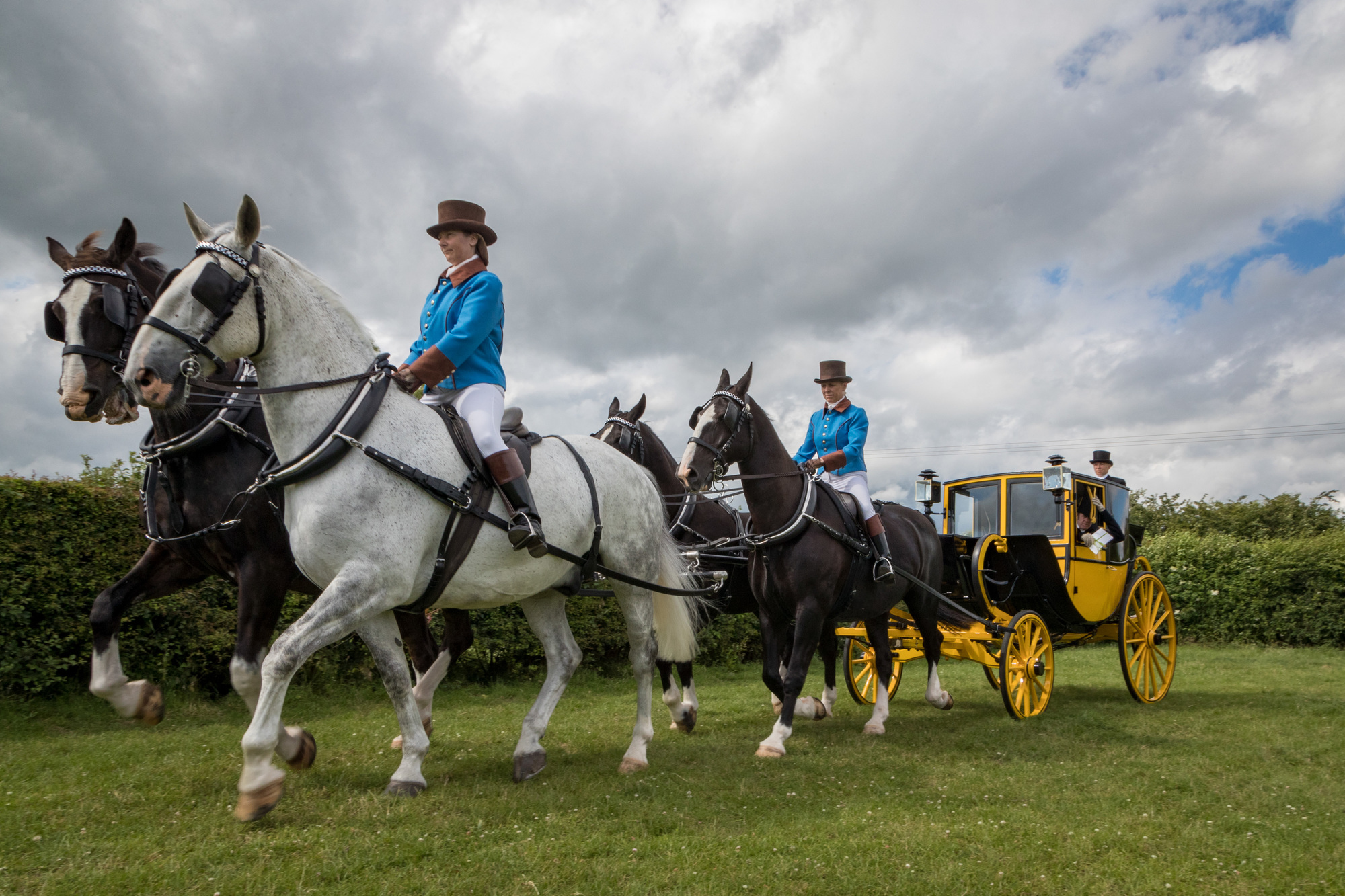
If you were in a real hurry, and had the money to spare, you could hire a post-chaise and achieve a hair-raising speed of eight to ten miles per hour. This was a small closed carriage, seating two people. There was no driver’s seat. The chaise would be drawn by two or four horses and rather than having a coach driver, the horses on the left-hand side of the carriage were ridden by postillions (also known as postboys), who wore smart uniforms with special leg-protectors for the right leg. The carriages were always painted bright yellow. The post-chaise would travel from posting station to posting station. Horses and postillions would be changed at each coaching inn, so that they were always fresh and capable of travelling as fast as possible. This relatively fast form of travel may be where the term “post haste” comes from. It’s been suggested that New York yellow cabs were inspired by the yellow coloured post-chaises.  There's a picture of a post-chaise here. 


We have three sets of relatives who ran inns in fairly close proximity along the route from London to the West Country. 


John Hall of Mapledurwell - died 1765. 

John was Mary Alice Willis’s 4X great-grandfather. Information on John is a bit lacking at the moment. He married Sarah Tees (born 1726, Sherfield-on-Loddon, Hampshire). They had three daughters, Sarah born 1751, Mary born 1753, and Aves born 1755, died 1759. 


John was an innholder at Mapledurwell Hatch, Hampshire. In his time it would have been a small village. Nowadays, it’s on the edge of Basingstoke, close to the M3 motorway. He left his property, which comprised the inn and land surrounding it, to his wife and then to his two surviving daughters. I haven’t been able to definitely identify the inn but think that it was probably the Hatch, previously known as the King’s Head. Google Maps street view.


John’s eldest daughter, Sarah Hall, married Joseph White of Staines in 1771. Joseph was the proprietor of the Bush Inn, Staines. There’s more to come about Joseph and Sarah and their family further down the page.


John’s second daughter, Mary Hall, was Mary Alice Willis’s 3X great-grandmother. Mary Hall married Michael Willis in 1772. They lived in Wraysbury until Mary’s death in 1804 and had one daughter, Mary Ann. Mary Ann married John Goodwin of Datchet and two of their daughters married back into the Willis line - complicated isn’t it?  Juliana Goodwin and Charles Willis were Mary Alice Willis’s great-grandparents. 


Michael Willis married again after the death of Mary Hall. His new wife was a widow, Ann May (maiden name Webb), she was also from the Basingstoke area and was related to some of our other forebears. 


Timothy Harris 1675 - 1748. 

Timothy was Mary Alice Willis’s 5X great-grandfather on another branch of the family leading into the Willis line. He was born in Salisbury but by about 1700 he was running the Red Lion Inn at Egham, not that far from Mapledurwell. After Timothy’s death the inn was run by his daughter Ann Harris until about 1784. 


The Red Lion is still in existence today Google Maps Street View . It was a large coaching inn with accommodation for 72 horses. I’ll write some more about Timothy in another story. 


Joseph White 1751 - 1810 and Sarah Hall 1751 - 1801.

Sarah Hall was Joseph’s second wife. They were married at Mapledurwell in 1771. They had seven children, including Harriet, who was born in 1776. Harriet became the wife of James Willis in 1794. James was the son of James Willis and Elizabeth Tebb and he was the elder brother of our ancestor, William Willis. After the death of their father in 1794 James and William ran the Thatched House Tavern and Almack’s Assembly Rooms. 


Joseph White was the proprietor of the Bush Inn at Staines. It was a large coaching inn, capable of stabling a hundred horses. In 1789, he announced in the Reading Mercury newspaper, that he had converted the Red Lion at Egham (see above) to an Assembly Room. There would be a ball and supper on the Tuesday of Easter week and in the future there would be balls, public breakfasts and card assemblies. 


Joseph’s business ventures don’t seem to have been a great financial success - a couple of phrases originated from there - being "at Staines" or "at the Bush" were euphemisms for being in financial distress - according to Google! In May 1795 a notice appeared in the Reading Mercury newspaper stating that Joseph White’s goods at the Bush Inn were to be sold by auction - presumably he was on the point of bankruptcy. The sale was to include his “entire stock of horses, carriages and harness &c comprising fifty eight capital-seasoned well-known good porte-chaise and machine horses, four milch cows, pigs &c, five post-chaises, a post coach, a waggon, two carts, a whisky and several lots of harness &c.” Presumably, he was bailed out at the last minute - he was still running the Bush Inn when he died in 1810. Sarah had died in 1801. The business was carried on by their eldest son, another Joseph. 


Joseph junior continued at the inn until 1827, when he moved to the Castle Inn at Marlborough - it subsequently became Marlborough College in 1843, after the arrival of the railway and a consequent loss of trade. The contents of the Bush Inn had been put up for auction, including 60 goose feather beds and handsome old and modern china. (I am on the lookout for some of the old china marked “White Bush Inn”!) Also up for sale were upwards of thirty posting horses in high condition, five post-chaises, two black mourning coaches, one hearse and harnesses.


The Bush Inn was demolished in 1832 when the old bridge over the Thames was removed and replaced with a new one. A new inn was built, it’s currently called The London Stone. Staines Town Hall, now known as the Old Town Hall, is situated approximately where the original Bush Inn stood. There’s a small picture showing the old inn here.


The Trafalgar Way.

In 1805 George III was on the throne and Britain was at war with France. An invasion by Napoleon was imminent. A battle at sea, off the southern coast of Spain, commenced at midday on the 21st of October 1805 - The Battle of Trafalgar. Admiral Villeneuve commanded the French and Spanish fleet. On the British side, Vice Admiral Collingwood was on board HMS Royal Sovereign, and Vice Admiral Nelson commanded from HMS Victory. By 5pm the battle was over, the French and Spanish were defeated but Nelson had been mortally wounded and died at about 4:15pm. 


Shortly after the Battle of Trafalgar ended a huge storm struck, delaying communication with Britain. Five days later Collingwood ordered Lieutenant John Richards Lapenotiere to deliver news of the victory and the death of Nelson to the Admiralty in Whitehall with all possible speed. Lapenotiere set off in his fast schooner, HMS Pickle, and landed at Falmouth, Cornwall on the 4th of November. He set off for London immediately in a post-chaise. He travelled 271 miles in 38 hours with 21 changes of horses along the way. The whole journey cost in excess of £4,000 in today’s money.


In 2005, 200 years after the battle, the journey was commemorated using a replica post-chaise and plaques were put up along the route where the horse changeovers occurred. 


On the 5th of November 1805 Lapenotiere made his 17th stop to change horses at Basingstoke at a cost of £1/14s. A plaque can be seen inside the Willis museum at the foot of the stairs. You can see a picture and map here. The Willis name in this case is purely coincidental. The next stop was Bagshot and to get there Lapenotiere would ride through Mapledurwell and pass by the Hatch. 


The next stop after Bagshot was Egham and a plaque has been installed on the High Street - picture here. The horses were still fresh, a change was not necessary so Lapenotiere continued on to his 20th stop - The Bush Inn at Staines. 


There are two plaques commemorating his arrival at Staines on the wall of the Old Town Hall in Market Square. An older plaque records the details of Lapenotiere’s arrival in Staines and also mentions that Nelson and Lady Hamilton actually stayed at the Bush Inn in 1802. The second plaque is in the same form as the previous ones along the route. I can’t find a photo that’s legible. Here is a transcription :-


“The Trafalgar Way Staines - 20th Post-horse change On Monday 21st October 1805 the Royal Navy decisively defeated a combined French and Spanish fleet off Cape Trafalgar on the south west coast of Spain. This victory permanently removed the threat of invasion of England by the armies of Napoleon Bonaparte. The first official dispatches with the momentous news of the victory, and the death in action of Vice Admiral Lord Nelson, were carried to England on board H.M. Schooner Pickle by her captain, Lieutenant John Richards Lapenotiere. Lapenotiere landed at Falmouth on Monday 4th November 1805 and set out "express by post-chaise" for London. He took some 37 hours on the 271 mile journey, changing horses 21 times. The 20th such change was made at Staines late on 5th November at a cost of one pound seventeen shillings and sixpence. Lapenotiere delivered his dispatches to the Admiralty at 1a.m on Wednesday 6th November. The news was at once passed to the Prime Minister and the King, and special editions of newspapers were published later the same day to inform the nation. Erected by Spelthorne Borough Council on 4th September 2005 to inaugurate The Trafalgar Way from Falmouth to London and to honour the men of Surrey who fought for their country at Trafalgar.”

Sunday, 2 November 2025

Rosa Rust 1925 - 2008

 This is a follow-up to my previous story about William Rust. It will make more sense to read that one first. The information is mostly gleaned from Francis Beckett’s book, Stalin’s British Victims. There was a 30 minute BBC Radio 4 programme made about Rosa, which was broadcast in August 1998. Unfortunately it doesn't seem to have made its way to BBC Sounds.


Rosa was born on the 26th of April 1925 at the Charing Cross Hospital, London. Her full name was Kathleen Rosa Rust but she was known as Rosa. Her parents were William Rust and Kathleen O’Donoghue. She was Mary Alice Willis’s second cousin 1X removed.


A few months after Rosa was born, William (Bill) was arrested and sent to prison for 12 months on a charge of seditious libel and incitement to mutiny. During her first year, Rosa only saw her father in the visitors room at Wandsworth Prison.


On his release from prison, Bill continued his work for the Communist Party cause and in 1928 he was appointed to a job at Comintern in Moscow. Kathleen and Rosa accompanied him. On arrival in Moscow, Rosa went down with scarlet fever and was confined to hospital for two weeks. Bill and Kathleen were not allowed to visit. The nurses didn’t speak English and Rosa didn’t speak Russian. She quickly learned to speak Russian and once she went away to school, English was soon forgotten. 


The family stayed at the Hotel Lux, a hotel where foreign communists stayed whilst in Moscow. It was convenient for the Kremlin and Comintern Headquarters. Bill and Kathleen (known as Kay) were both leading busy lives, Kathleen had a job as a junior reporter on the Moscow Daily News and Bill was becoming more important at Comintern. Rosa was left to her own devices and fell in with gangs of children on the street, “I became a little hooligan, stealing things in shops for the excitement. It was better than sitting at home, alone.”


Bill returned to Britain to launch the Daily Worker newspaper at the end of 1929. By this time he and Kathleen had parted company and Bill had taken up with Tamara Kravets. The timeline becomes a bit confused here, but it seems that Bill returned to Comintern in Moscow at the end of 1932 and then went back to Britain in the mid 1930s. Kathleen and Rosa didn’t go back to Britain. 


In 1933 Rosa had another visit to the hospital, this time to have her tonsils removed. In Russia at the time it was the practice to carry out the operation without anaesthetics. Kathleen had the flu at the time and Bill was busy with important Comintern business, so Tamara was designated to accompany Rosa to the hospital. The two did not get on. Tamara dumped Rosa at the hospital and left Rosa to it, much to the annoyance of Kathleen. 


Because of Bill’s importance in a foreign communist party, Rosa was entitled to a place at the Ivanova-Vosnesensk boarding school. Pupils at the school included the children of China’s Mao Tse-Tung, Yugoslavia’s Marshal Tito and Hungary’s Matyas Rakosi. 


While Rosa was away at school, Kathleen became involved with, and possibly married, a Russian man by the name of Misha. Rosa liked him very much, describing him as “kind and bubbling, a bear of a man”. The secret police came for him at 3am in the morning in early 1937. He was shot soon afterwards. He is thought to have been charged with Trotskyism. It was necessary for Kathleen to get out of the country as quickly as possible to avoid suffering the same fate. She made a hurried visit to Rosa at school and promised to come back soon to collect her. Kathleen did not return. 


Rosa had to leave school at the age of 15 and in 1940 she was sent to a hostel for political immigrants in Moscow. There were fifty or so other young people of the same age and Rosa liked it there very much. In 1941, when the Russians joined the Second World War, she was supposed to be studying for examinations. She was spending too much time enjoying herself and didn’t achieve the required grades. The rest of her fellow students were sent on holiday to the country and then back to their old school. Rosa was left behind in Moscow. 


She was assigned to join a group of Germans and they were told that they would be assisting the war effort. They spent several days travelling to Stalingrad and then they travelled by barge down the River Volga to a small village in the Volga German Republic, close to the front. She made friends with a German woman. Rosa was allocated 12 hour shifts at a canning factory. 


After about three months, Rosa was on the move again. Stalin believed that the Volga Germans were ready to welcome an invasion from the advancing German army. There was a three day journey across the Caspian Sea by ferry and then a train journey in cattle trucks. Food was very scarce. She was put to work in a copper mine about 100 miles from the Chinese border. 


Eventually, Rosa decided to write to a former school friend to ask for help. The letter was passed to the head teacher and in early 1943, Rosa received a pass, signed by the head of Comintern, together with 500 roubles to get her to Moscow. The journey took weeks. Trains were in short supply and overcrowded. Eventually, she arrived back at the Hotel Lux. A cable was sent to Bill Rust, Rosa had to decide whether to stay in Moscow or travel to Britain. She decided to come back to Britain. It was arranged with the British Embassy that Rosa would travel with a convoy of ships from Murmansk to Leith in Scotland, a journey of three weeks. One ship in the convoy was sunk and German planes opened fire on the men in lifeboats. 


From Leith she travelled to Edinburgh by train. Not an easy journey as by this time she spoke no English and couldn’t read the station signs. Foreign Office officials met her at Edinburgh and a couple of days later she was put on a train to Euston, London, where her parents met her. It took a while to recognise each other as it had been such a long time since they last saw one another. 


Rosa went to live with Kathleen in London and set about learning English again, although apparently she retained a strong Russian accent for the rest of her life. 


Thursday, 30 October 2025

"Round and Pink and Cold as Ice"

 William Rust 1903 -1949

As you can see from the chart above, William Rust was Mary Alice Willis’s second cousin on her mother’s side of the family. They were both great-grandchildren of Charles Treavish and his wife Mary. William and Mary Alice were similar ages and were both born and brought up in South London, only a few miles apart. I guess that it’s possible that they might have met as children.

William Rust was born on the 24th of April 1903 and was baptised at St Luke’s Church, Peckham on the 15th of May 1903. He was the second child of Frederick and Eliza Rust. Frederick was a bookbinder. 

The early 1900s were a time of great change for Britain and the western world. Queen Victoria died in 1901 and the First World War was fought between 1914 and 1918. In 1917 the Russian Revolution led to the execution of Tsar Nicholas and the rise of the Bolsheviks. Vladimir Lenin became leader of Soviet Russia and then the Soviet Union from 1917 until his death in 1924. A period of instability followed until Joseph Stalin achieved undisputed leadership by around 1929. The Spanish Civil War erupted in 1936 and this was followed by the Second World War, fought between 1939 and 1945. From 1947 the Cold War was taking hold.

William Rust was too young to have fought in the First World War. He left school at the age of 14 in 1917. One of his first jobs was at Hulton’s Press Agency. He was sacked from that job after leaking the news that a prominent trade unionist was selling information to the agency. Later on he worked for a short time for Sylvia Pankhurst’s paper, Worker’s Dreadnought. Sylvia was a daughter of Emmeline Pankhurst and was a political activist and suffragist. At the time of the 1921 census William was working as a clerk for the Sheet Metal Workers Union.

In 1919, Lenin had established the Communist International (known as Comintern) in Moscow, with the purpose of promoting world communism. It would be the Soviet means of control over international communist parties. The Communist Party of Great Britain was formed under its auspices in the summer of 1920 and William Rust was one of the first to join. The Young Communist League (the youth wing) was formed in 1921 under the leadership of William (Bill) Rust and Dave Springhall. 

“Rust was described by a colleague in 1928 as ‘round and pink and cold as ice’ He was tall, plump and just 25. Few people saw him smile and no one seems to know what made him tick ……….. Together they turned the Young Communist League into a Comintern watchdog, looking over Inkpin’s shoulder and ensuring there was no shilly-shallying. It was to be the new line, all the new line and nothing but the new line or Bill Rust would know the reason why”  - from ENEMY WITHIN The Rise and Fall of the British Communist Party by Francis Beckett. 

In 1921 Bill Rust and Clara Gilbert Cole formed Camberwell Organized Unemployed. An attempt to overturn the eviction of people living in cottages in Ormside Street, Camberwell resulted in his arrest and he was sent to prison for 28 days.

In 1923 Bill joined the executive of the Communist Party of Great Britain as a representative of the Young Communist League. 

In 1924 William Charles Rust married Kathleen O’Donoghue (known as Kay) in a Registry Office in Camberwell. In the same year he attended the 5th Congress of the Comintern in Moscow.

William and Kathleen’s daughter, Kathleen Rosa Rust, was born on the 26th of April 1925. On the 25th of August 1925 Bill was arrested along with eleven other activists. As members of the British Communist Party they were charged with violation of the Mutiny Act 1797. It was believed that the arrests were an attempt by the Government to weaken the labour movement in preparation for the impending General Strike. Bill was sentenced to 12 months imprisonment as he already had a previous conviction. Others were sentenced to 6 months. On the 12th of February 1926 an article appeared in The Workers’ Weekly. It was written by Kathleen Rust and described a visit to her husband in Wandsworth Prison under the heading “A VISIT TO PRISON - Elaborate Ceremony, Polite Warders - and a huge key - SUSPICIOUS OF CHINESE”

In 1928 Bill attended another Comintern Congress where he denounced the leadership of the British Communist Party. Comintern demanded changes and Harry Pollitt became the new leader of the party. 

In 1928, according to Francis Beckett’s book “Stalin’s British Victims”,  William Rust became the British Communist Party’s representative at Comintern and headed to Moscow with his wife and daughter. During that time he and his wife, Kathleen, separated and Bill became involved with a Russian by the name of Tamara Kravets, who accompanied him back to Britain. When Bill returned to Britain, Kathleen and Rosa remained in Moscow. 

In October 1929 Bill attended a sitting of the Communist Youth Congress in Paris. He was arrested at the close of the meeting and the authorities declared that he would be expelled from the country as soon as an expulsion order had been signed by the Minister of the Interior. 

The Daily Worker newspaper launched on the 1st of January 1930 on a shoestring budget. William Rust was appointed editor, although he had little experience in the newspaper industry apart from his short time at the Hulton Press. He had also edited “The Young Worker” for the Young Communist League and had written a number of articles and pamphlets. In his words, “I was pitchforked into the job. It was my reward, I suppose, for my somewhat persistent advocacy of the importance of a Communist daily in Britain”. Initially, there was a staff of 8 men and 1 woman, none of whom had experience of working on a daily paper. 

The first year was spent overcoming problems, not least of which was the newspaper wholesalers refusing to distribute the paper to the newsagents. A distribution system had to be devised. Established newspapers reacted to the new paper with fury and attacked it through their columns. Financial restraints meant that an edition consisted of only a few pages. On the 4th of January 1930 an article titled “by Candlelight in an Old Grimy Warehouse” recounted the story of the first issue, “Working by candlelight and with freezing feet we got out the first working-class daily in Britain.” “Although the office is cold, the Daily Worker and the workers around us are afire with the invincible revolutionary spirit of the working class”.

Lawsuits abounded but the paper struggled on. Among its targets was a campaign against the rise of fascism and Oswald Mosley. Bill remained editor of the paper until 1932, when he returned to Moscow to work for Comintern (The Story of the Daily Worker by William Rust). It seems that he remained in close touch with what was going on at the paper and returned to the editorship from 1939 until 1948. “He (William Rust) was a fine editor: a cynical boss who thumped the table in his furious rages, he nonetheless inspired journalists' best work. A tall and by now heavily built man, Rust was one of the Party's most able people, and one of the least likeable.” - ENEMY WITHIN The Rise and Fall of the British Communist Party by Francis Beckett.

Upon his return to Britain, Bill spent time as Party Organiser in Lancashire and then as National Organiser at Party Centre.

Meanwhile, back at the Daily Worker, 1933 saw an arson attack on the Reichstag (Parliament) building in Berlin. Hitler had been sworn in as Chancellor of Germany a few weeks before and a group of Communists were blamed for the attack, leading to a suspension of civil liberties and a tightening of the Nazi control over the Germany. So far as Bill Rust and the British Communist party were concerned, the arsonists had been the Nazi party itself in order to rig the election, which took place shortly afterwards.

In 1936, in Britain, there was the Battle of Cable Street. A proposed march by Oswald Mosley and his supporters was thwarted by a counter-protest. The Daily Worker had urged its readers to take part in the counter-protest. 

July 1936 saw the start of the Spanish Civil War, a military uprising against the Republican government of the time. The uprising was led by General Francisco Franco. The Republican government eventually surrendered in 1939 and General Franco became the dictator leader of Spain until his death in 1975. Germany and Italy, fascist countries led by Hitler and Mussolini, sent troops and arms to assist the fascist rebels. France and Britain declined to assist the government of Spain. Anti-fascists began travelling to Spain to help in the struggle against the rebels. Russia sent aid to the Government forces and Comintern organised the formation of the International Brigades for foreign volunteers, including the British Battalion of the 15th Brigade. 

Bill Rust travelled to Spain in November 1937, ostensibly as correspondent for the Daily Worker, but also as a senior Commissar for Comintern. He had an office in Barcelona and when the fighting was close by he would visit the front lines every day. He carried a handgun. Bill stayed in Spain until June 1938. The International Brigades were disbanded in September 1938. On his return to Britain he wrote a detailed, if rather skewed, account of the civil war from the point of view of the British Battalion. It’s very readable and mentions many of those who took part in the fighting, acknowledging the part they played in the struggle. - BRITONS IN SPAIN, THE HISTORY OF THE BRITISH BATTALION OF THE XVTH INTERNATIONAL BRIGADE by William Rust. 

In the 1939 census, Bill and Tamara were shown living in Wandsworth with Bill’s younger sister. They were described as married and Bill’s occupation was commercial clerk. They didn’t actually marry until 1948. Bill’s first wife, Kathleen, was to be found in Hornsey, working as a shorthand typist for a solicitor. She had reverted to her maiden name of O’Donoghue. There’s no sign of their daughter, Kathleen Rosa Rust, who was known by her middle name, Rosa Rust. She wasn’t in the country. There’s more to come about that in my next story. 

When Britain and France declared war on Germany after the invasion of Poland in 1939, Harry Pollitt, leader of the British Communist Party, supported the war. Unfortunately Russia was not in favour of the war at the time. Pollitt was forced to resign and the leadership of the Party was reorganised. Bill Rust was reappointed to the editorship of the Daily Worker and articles appeared opposing the war. On the 21st of January 1941 the Daily Worker was suspended by the Home Secretary, Herbert Morrison, for undermining the war effort. On the 22nd of June 1941 Germany invaded Russia, and Russia then became Britain’s ally. Harry Pollitt was reinstated as leader of the party.  Publication of the newspaper recommenced on the 26th of August 1942 and the Daily Worker became an enthusiastic supporter of the war. 

William Rust stood as the Communist candidate for South Hackney in the 1945 General Election. The Labour candidate, Herbert Butler, won the seat with 10,432 votes, the Liberal candidate came second with 4,901 votes and Bill came a close third with 4,891 votes. He was adopted as the Communist candidate for South Hackney again in 1948.

By the end of the Second World War, support for the Communist Party was high and by 1948 the Daily Worker had its highest ever circulation figures at 120,000. Comintern had been dissolved by Stalin in 1943 and there was less Soviet influence over what should be published in the paper. Bill was on a mission to turn the Daily Worker into a paper which could compete with the National Dailies. He was permitted (formerly forbidden) to print racing tips and to make the paper more interesting and “fun”. Presumably, the fun was less easy to achieve as the Cold War began to ramp up from about 1947 onwards. He was known to loathe journalists and when it was pointed out that he worked with them every day he responded, “They’re not journalists. They’re Communists” (Francis Beckett).

William Rust and Tamara Kravets were married in 1948. According to Francis Beckett in “Stalin’s British Victims”, the Communist Party was keen to give an appearance of respectability, so the fact that he had a previous wife and daughter was to be kept under the radar. Tamara had her own secrets - her architect father left the USSR on a trip to Germany in 1927 and refused to return to his home country.

On the 3rd of February 1949 Bill attended meetings during the daytime and was due to appear before the Central London branch of the National Union of Journalists in the evening to defend an article he had written headlined “Fleet Street dungheap”. He was also due to meet his daughter Rosa, who wanted to introduce him to her husband-to-be. During one of the meetings he said that he felt ill and then collapsed. He was dead on arrival at Charing Cross Hospital at the age of 45. He is described as having had either a massive stroke or a massive heart attack. 

Bill’s funeral was planned by the Communist Party. There was to be a procession through the streets. Kathleen and Rosa were asked not to attend as Bill had recently married Tamara. Kathleen complained loudly and party leader Harry Pollitt reversed the decision. According to Francis Beckett, in his book mentioned above, Kathleen and Rosa walked in front of the coffin and 5,000 people lined the streets. 

In 1954 the widowed Tamara Rust became the third wife of Wogan Philipps, 2nd Baron Milford. He was the only member of the British Communist Party to sit in the House of Lords. Philipps died in 1993, Tamara died in 2008.

I’ll write some more about Kathleen and Rosa Rust in my next story.

Sources

Books

Stalin’s British Victims by Francis Beckett

Enemy Within. The Rise and Fall of the British Communist Party by Francis Beckett

Britons in Spain, the History of the British Battalion of the XVth International Brigade by William Rust

The Story of the Daily Worker by William Rust

Internet

Wikipedia

Oxford Dictionary of National Biography

William Rust https://spartacus-educational.com/TUrust.htm

Tamara Rust https://grahamstevenson.me.uk/2010/01/05/phillips-tamara-rust


Timeline

  • 1903 Born 24 April 1903

  • 1911 Census

  • 1917 left school aged 14 

  • 1917 Russian Revolution

  • 1917 Hulton’s Press Agency (sacked)

    • Worker’s Dreadnought (Sylvia Pankhurst)

  • 1917 - 1924 Vladimir Lenin leader of Soviet Russia and Soviet Union

  • 1919 First Congress of Communist International (Comintern). The Communist International, or Comintern, was an organization founded in Moscow in 1919 with the goal of promoting world communism. Established by Vladimir Lenin and the Russian Communist Party, it aimed to spread the Russian Revolution globally and serve as an instrument of Soviet control over international communist parties. The Comintern existed until 1943, when it was dissolved by Joseph Stalin. 

  • 1920 Formation of the Communist Party of Great Britain

  • 1921 Census

  • 1921 Formed Camberwell Organized Unemployed with Clara Gilbert
    Cole. Arrested for attempting to overturn the eviction of people living in cottages in Ormside Street, Camberwell. Imprisoned for 28 days.

  • 1921 Formation of the Young Communist League

  • 1923 Joined the executive of the CPGB as a representative of the Young Communist League.

  • 1924 Married Kathleen O'Donoghue

  • 1924 Attended the 5th Congress of the Comintern, held in Moscow

  • 1924 Death of Lenin following ill health, during which time Stalin, Kamenev and Zinoviev were a triumvirate.

  • 1924 Stalin gradually ousted Trotsky and became sole leader over a period of years.

  • 1925 26th April. Birth of Rosa Rust 

  • 1925 25 August. Arrested with 11 other activists for being a member of the Communist Party of Great Britain and charged with violation of the Mutiny Act 1797. Sentenced to 12 months imprisonment. (letter printed to young communists paper by Kathleen Rust)

  • 1928 Denounced CPGB leadership at the Comintern Congress

  • 1928 Move to Moscow

  • 1929 Arrested in Paris and deported.

  • 1930 Editor of the Daily Worker

  • 1932 CPGB’s representative in Moscow.
    Party Organiser in Lancashire
    National Organiser at Party Centre

  • 1933 Reichtag fire

  • 1936 Battle of Cable Street (Oswald Moseley march)

  • 1937-1938 The Daily Worker’s correspondent in Spain during the Spanish Civil War. The British senior Commissar and a Comintern representative with an office in Barcelona.

  • 1939 Census

  • 1939-1941 Opposed WW2 until Germany invaded the Soviet Union on 22nd of June 1941. Rust Took over editorship of the Daily Worker again. Speaker at meetings.

  • 1940 Trotsky assassinated

  • 1941 21st January. Daily Worker suspended by Home Secretary, Herbert Morrison, for undermining the war effort. Reinstated 26th August 1942.

  • 1948 Married Tamara R Kravets

  • 1949 3rd of February. Suffered a massive heart attack/stroke during/before meeting. Pronounced dead at Charing Cross hospital